
Independent Design Review and a paragraph 84e consent in Wiltshire

Updated: Jun 23

Introduction
Most case studies for independent design review lead with the endorsement. This one leads with the challenge.
When the scheme for a new country house on land to the north of Cross Lanes Farm, near Leigh in north Wiltshire, is first presented to The Design Review Panel in April 2023, the Panel's written feedback is candid. Notwithstanding more than two years of design development, the Panel records that the proposal has "not yet met the extremely high bar" of national policy for an isolated home of exceptional quality.
That is not a setback. It is the point.
Paragraph 84(e) of the National Planning Policy Framework is one of the most demanding tests in the English planning system. A proposal that clears it on a first attempt is the rare exception, not the rule. The value of independent design review lies precisely in its willingness to say, early and on the record, where a scheme stands against that bar — so that the design team can respond before, not after, an application is determined.
The scheme returns to Wiltshire Council, is assessed against Paragraph 84(e), and is granted full planning permission at committee.
This is what rigorous, independent, iterative review looks like in practice.

What Paragraph 84(e) Requires
Paragraph 84(e) of the National Planning Policy Framework provides a narrow exception to the general presumption against isolated homes in the countryside. To succeed, a proposal must satisfy a two-limb test:
The design must be truly outstanding, reflecting the highest standards in architecture, and would help to raise standards of design more generally in rural areas.
It must significantly enhance its immediate setting and be sensitive to the defining characteristics of the local area.
The threshold is intentionally rigorous. A Paragraph 84(e) submission must demonstrate exceptional architectural and landscape quality through evidence — not assertion.
It is worth noting a point of policy history that this case illustrates well. When the Panel first reviews the scheme in April 2023, the relevant provision sits at Paragraph 80(e) of the then-current Framework, and the design-review provision at Paragraph 133. The December 2024 edition of the Framework renumbers these to Paragraph 84(e) and Paragraph 138 respectively, with the substance of the exceptional-quality test carried through. The bar does not move. Only its number does.
Paragraph 84(e) does not yield to opinion. It yields to evidence.
The Site
The site sits within an isolated location in open countryside a short distance to the north of the hamlet of Leigh, near the edge of the Cotswold Water Park and close to the county border with Gloucestershire. The surrounding context is emphatically rural: a landscape of small villages and dispersed farmsteads, with field patterns ranging from small and irregular to medium-sized regular fields of later enclosure.
The site is predominantly grassland, lined by hawthorn hedgerows, with mature trees grouped to its southern corner. It slopes gently from north-east to south-west and is obscured from most public views by intervening trees and boundary vegetation, which gives it a distinctively secluded and rural character. There are no public rights of way through or adjoining the site, and — beyond its open-countryside location — no other notable designations or constraints. The development plan does not, as a matter of principle, support new residential development in such a location unless a rural exception applies.
That is the policy starting point against which an exceptional-quality proposal must be tested.
The Proposal
The proposal, developed by Studio Benjamin Machin, is for a new dwelling with associated studio, stable and field-shelter buildings, a new access, and the change of use of the land to a mix of domestic use, the private keeping of horses, and areas for biodiversity net gain.

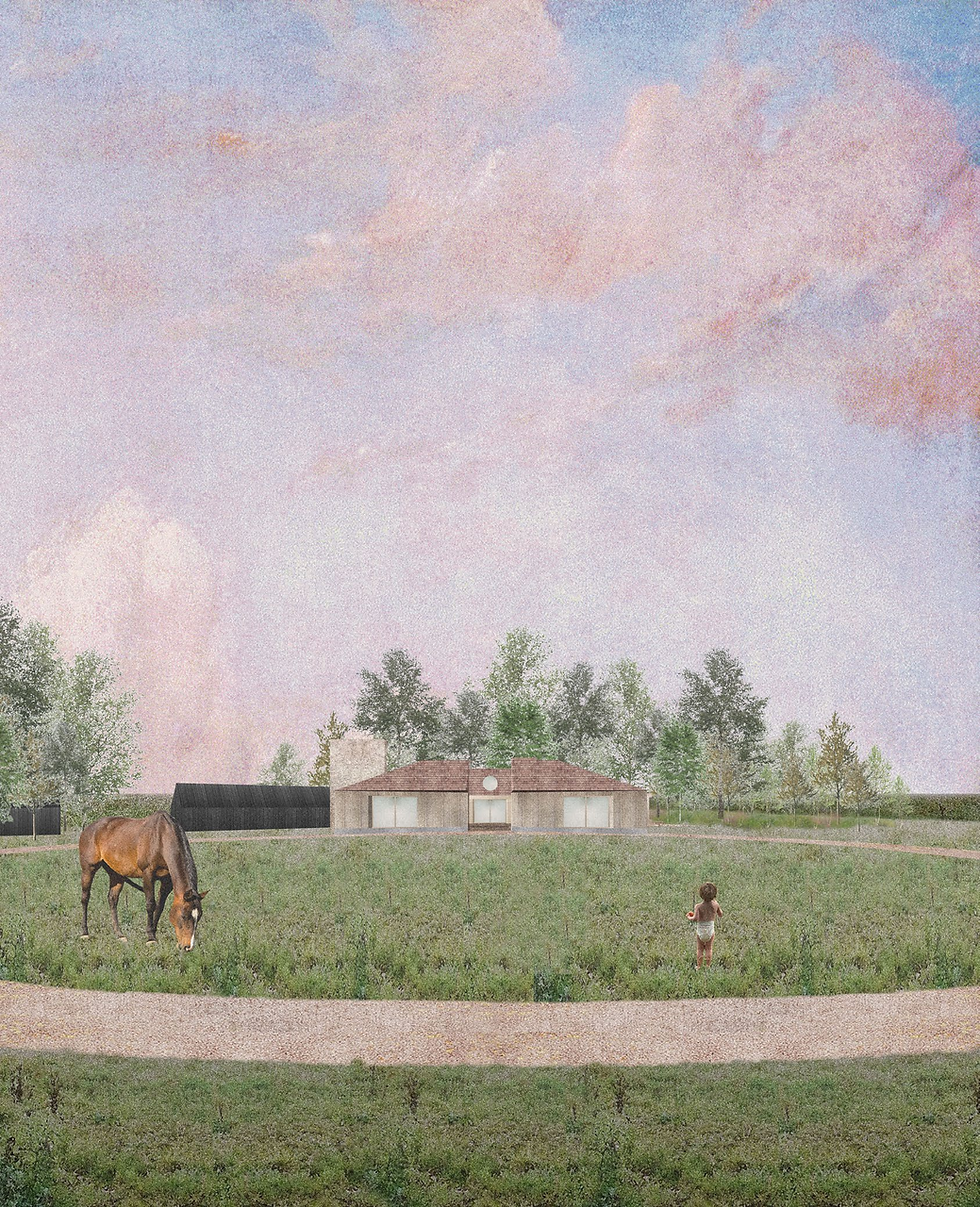
The architectural approach does not treat the house as an isolated object placed upon a field. It is conceived as a contemporary farmstead: a whole-site composition in which the dwelling and its ancillary pavilions are arranged to refer to the local farmstead vernacular, set around a central circular meadow, and built using highly sustainable natural materials. The house itself is a contemporary translation of a courtyard typology, derived from close study of the site's topography, hedgerows, field patterns and the equestrian history of the surrounding land.
This is a coherent, authored architectural proposition — a building drawn from its place rather than imposed upon it.
Independent Design Review: A Candid First Reading
The scheme is reviewed by the Panel in April 2023. The Panel is a national, multidisciplinary, independent design review service operating in accordance with the principles set out in Design Review: Principles and Practice and reflecting the expectation in paragraph 138 of the National Planning Policy Framework that local planning authorities have regard to the outcome of design review processes when assessing applications.
Paragraph 84(e) is not a design competition; it is a policy test. Proposals very rarely succeed in a single iteration. Exceptional quality is most reliably reached through structured, iterative scrutiny — a process by which siting, scale, mass, materiality, sustainability and landscape strategy are tested and refined. The Panel's role is to interrogate, not to validate.
The Panel welcomes the early engagement as best practice and commends the clarity of the presentation and the rigour of the design process, noting that the scheme "seems devoid of any randomness" and that there is "a clear rationale for every design choice made". It also records, plainly, that the proposal has not yet met the threshold:
"Overall, the Panel is extremely supportive and, notwithstanding the large amount of work that has been undertaken, appreciates the Design Team engaging at an informative stage. Notwithstanding this, it is not considered that the proposals have yet met the extremely high bar of paragraph 80(e) of the National Planning Policy Framework." — The Design Review Panel, written feedback, 19 April 2023
That single finding is the editorial keystone of this case. It is not lobbying for the scheme; it is testing it.
The Panel's feedback is constructive and specific. It suggests presenting the site not as something tucked away but as "a participant in a larger landscape, visible and proud"; mapping the local landscape cues that inform the design so that their relationship to the site is legible; producing a landscape statement from a landscape architect to substantiate the design against local landscape character; bringing the ecologist and rewilding specialist's findings more centrally into the proposals; reconsidering the planting scheme around the equestrian areas; and expanding the design focus from the house to the site as a whole.

Each of these is a route to evidence. Together they describe the distance between a strong scheme and an exceptional one — and how that distance might be closed.
"The project is a new country house and equine landscape in north Wiltshire ... The design process involved extensive iterative development through both pre-application engagement with Wiltshire Council and the Design Review Panel process. The DRP session in April 2023 formed an important part of testing the project critically and helped refine aspects of the siting and landscape integration." — Benjamin Machin, Studio Benjamin Machin
From Feedback to Determination
In the period following the Panel's session, the scheme is developed further through continued pre-application engagement with Wiltshire Council and refinement of its landscape and whole-site strategy. A full planning application is subsequently submitted under reference PL/2025/04154.
The officer report to committee records that the scheme is the product of "an extensive, collaborative design and consultation process" begun in 2020, and that its design "has evolved through extensive local analysis, pre-application engagement with the local planning authority and advice received from Design Review Panels at various stages of the design process". The report frames the result as a "whole-site design comprising the house, ancillary pavilions and gardens arranged to refer to the local farmstead vernacular".

The report is clear about the policy gateway. As an isolated dwelling in open countryside, the development can only be justified if it meets the exceptional-quality exception. Core Policy 57 of the Wiltshire Core Strategy sets the criteria for high-quality design; in this case, the officer report observes, the design "must be considered to go beyond high-quality and instead must be exceptional if it is to be able to be supported by NPPF para. 84e".
Following its referral to committee, the application is granted full planning permission.
Paragraph 138 of the NPPF and the Role of Design Review
Paragraph 138 of the National Planning Policy Framework states that local planning authorities should, when appropriate, seek the views of statutory and non-statutory consultees, including independent design review panels, and have regard to their assessments where relevant.
The Cross Lanes Farm sequence illustrates the practical purpose of that provision. Independent design review is most effective when it is engaged early, applied honestly, and carried through to determination. Here, the Panel's involvement is recorded in the officer's own account of how the design evolved — the design-review process treated as part of the evidential narrative rather than as an afterthought.
The case is a worked example of why design review feedback is most useful when it is candid at the outset. A review that only confirms what a design team hopes to hear adds nothing to the evidence base. A review that identifies, early and on the record, the distance still to travel gives the design team something to work with — and gives the decision-maker confidence that the proposal has been independently tested.
Paragraph 139 and Significant Weight
Paragraph 139 of the National Planning Policy Framework provides that significant weight should be given to outstanding or innovative designs that promote high levels of sustainability or help to raise the standard of design more generally in an area, where these fit within the grain of their surroundings.
A Paragraph 84(e) proposal that satisfies the exceptional-quality test is, by definition, the kind of scheme to which Paragraph 139 speaks. A whole-site composition drawn from the local farmstead vernacular, built in sustainable natural materials, and integrated with a restored and biodiverse landscape is precisely the sort of design that national policy intends to reward where it genuinely clears the bar.
What Cross Lanes Farm Demonstrates
Land to the north of Cross Lanes Farm sits alongside Spilsby House (East Devon, 2025) and Tunwold (Chadlington, 2026) as part of a growing body of publicly evidenced cases for the role of independent design review in Paragraph 84(e) decision-making in England.
Each case is different. Some demonstrate the value of independent review when a scheme is overridden and tested again at appeal. This one demonstrates something quieter and, in its way, more fundamental: the value of an independent voice that is willing to say "not yet" at the start, so that the design team can do the work that a genuinely exceptional scheme requires.
In all cases, the common thread is the same. The Panel's professional judgement is independent of the applicant and of the local planning authority. It is offered as scrutiny, not advocacy. Where that scrutiny is engaged early and respected through to determination, it strengthens the evidence base on which an exceptional-quality case is built.
What This Means for You
Conclusion
The strongest evidence for the value of independent design review is not always a glowing endorsement. Sometimes it is a candid finding, delivered early, that a scheme has not yet met the bar — and the design that follows in response.
Land to the north of Cross Lanes Farm is a scheme that was tested honestly, refined patiently over several years, and granted permission as an isolated dwelling of exceptional quality. The Panel's role was not to secure that outcome. It was to interrogate the proposition rigorously, on the record, against the highest standard national policy sets.

Paragraph 84(e) does not yield to opinion. It yields to evidence. Cross Lanes Farm is the evidence.
About the Panel
Frequently Asked Questions
What is Paragraph 84(e) of the National Planning Policy Framework?
Paragraph 84(e) is a narrow exception in national planning policy that allows an isolated home in the countryside where the design is of exceptional quality, reflecting the highest standards in architecture, helping to raise standards more generally in rural areas, and significantly enhancing its immediate setting. The threshold is intentionally high.
What weight does the National Planning Policy Framework give to independent design review?
Paragraph 138 of the National Planning Policy Framework states that local planning authorities should, when appropriate, seek the views of statutory and non-statutory consultees, including independent design review panels, and have regard to their assessments where relevant.
Why did the Panel conclude the scheme had not yet met the bar?
At its first review in April 2023, the Panel found the proposal strong and rigorously developed but considered that it had not yet demonstrated the exceptional quality that Paragraph 84(e) requires. The Panel set out specific, constructive areas — landscape strategy, the legibility of the local design cues, the whole-site approach and the supporting landscape and ecological evidence — where further work could help close the distance between a high-quality scheme and an exceptional one.
What changed between the Panel's review and the grant of permission?
The scheme was developed further through continued pre-application engagement with Wiltshire Council and refinement of its whole-site and landscape strategy. A full planning application was subsequently submitted and assessed against the exceptional-quality test, and full planning permission was granted at committee.
Can a planning committee refuse a Paragraph 84(e) scheme that officers support?
Yes. Planning committees are entitled to depart from officer recommendations. Where they do, the architectural and policy reasoning is tested independently by a Planning Inspector if the applicant appeals.
How does The Design Review Panel engage with applicants?
The Panel engages with applicants from the earliest stages of design development, applies structured multidisciplinary scrutiny across one or more iterations, and produces an evidential record that can be relied upon by local planning authorities, Planning Inspectors and elected members. Engagement is most effective when it is early, honest and respected through to determination.
Is The Design Review Panel independent of local planning authorities?
Yes. The Panel is a national, independent, multidisciplinary design review service. Its feedback reflects the professional judgement of its members and is not directed by, or accountable to, any local planning authority or applicant.


Comments