
Planning Reform 2025: Sanctions, Accountability and the Rising Importance of Design Review Panels

Updated: Sep 9
In recent months, the political landscape around housing and planning in England has shifted decisively. Announcements from Government signal a recalibration of responsibility and accountability in the planning process. Local authorities and developers alike are facing new forms of scrutiny designed to accelerate delivery while improving consistency and design robustness.

These changes have profound implications for how development proposals are prepared, assessed, and brought forward — and they underscore the growing importance of independent design review as part of a credible planning strategy.
Councils and the 5% Threshold
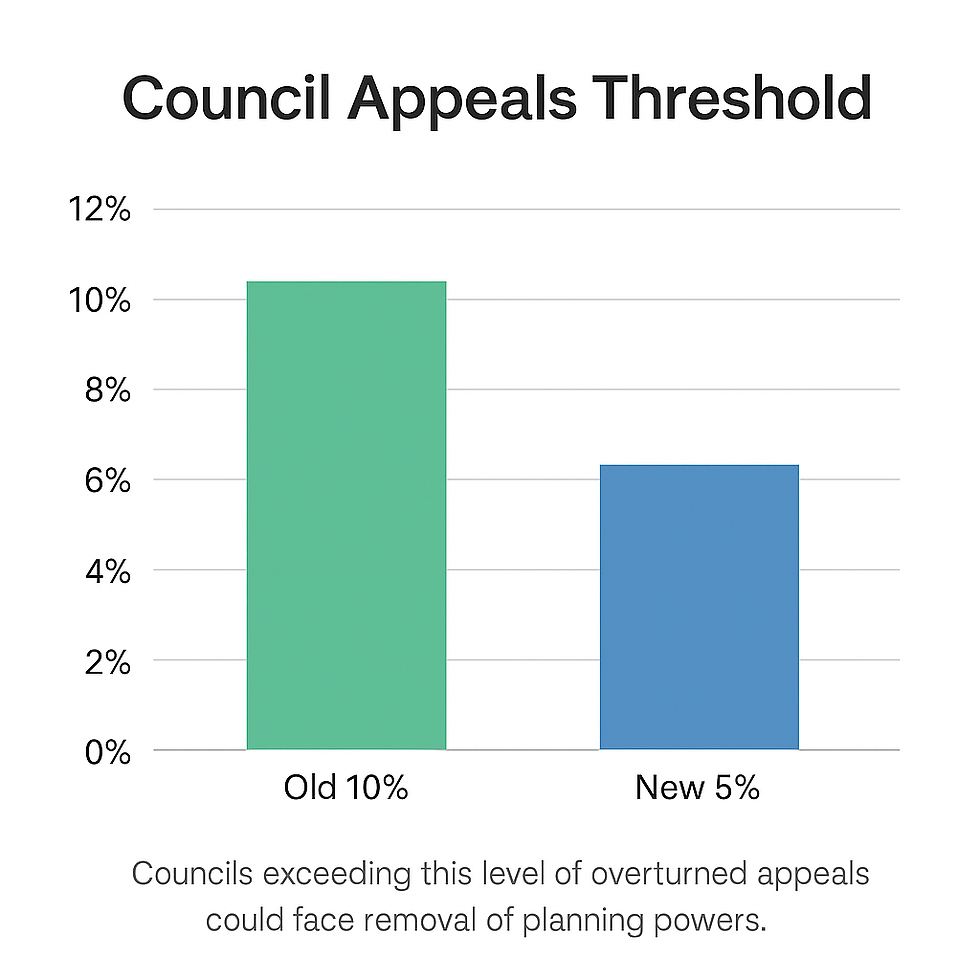
Perhaps the most striking policy signal comes from the proposal that councils in England which exceed a 5% appeals overturn rate could face removal of their planning powers, as confirmed by Deputy Prime Minister Angela Rayner’s recent comments on tightening accountability. This represents a substantial tightening of the system, lowering the tolerance from the current 10% benchmark. The rationale is clear: central government wishes to address under-delivery and perceived obstruction by ensuring that refusals are robust, defensible, and aligned with national policy priorities.
For local authorities, this change would mean that any refusal not underpinned by strong evidence, high-quality design reasoning, and clear policy alignment could carry significant institutional risk. The potential removal of planning powers from councils is not merely a technical adjustment; it reshapes the relationship between local discretion and national oversight. For developers, it creates a parallel incentive: to ensure that their schemes are designed to a standard that can withstand both officer scrutiny and the rigour of appeal.
Developer Accountability and Delivery Timelines
Alongside this, proposed reforms developers must agree to a construction timeline before planning is granted, report progress annually, and may face fines (e.g., a ‘delayed homes penalty’) or even future permission restrictions if they fall more than 10% behind schedule.
“We’re going even further to get the homes we need. No more sites with planning permission gathering dust for decades…” — Angela Rayner

This represents a cultural shift in planning. The focus is no longer only on whether a scheme gains approval, but on whether it is delivered promptly and as promised. It is a direct response to longstanding criticisms that developers “land bank” or fail to build out consented schemes, thereby undermining housing targets. The new accountability framework effectively extends the life of the planning process beyond determination and into delivery.
These proposed reforms are part of a broader drive to deliver 1.5 million homes during this parliament, with sanctions intended to tackle under‑delivery and project delays.
The Role of Design Quality
In both strands of reform — tighter thresholds for councils and stricter accountability for developers — design quality is a central, if sometimes understated, theme. Local authorities will need to evidence refusals based on defensible design principles, ensuring that objections are not vulnerable to being overturned at appeal. Developers, in turn, will need to bring forward proposals that are not just expedient, but demonstrably robust in their response to context, sustainability, and policy objectives.

Here, independent design review assumes a heightened importance. By securing impartial, multidisciplinary feedback at an early stage, applicants can ensure that their schemes are prepared to withstand scrutiny under the evolving regime. For local authorities, inviting projects to The Design Review Panel provides an evidential basis for decision-making, helping to demonstrate that refusals (or indeed approvals) rest on considered, expert grounds.
Strategic Implications for Applicants and LPAs
Taken together, these reforms point towards a planning environment characterised by greater accountability, reduced tolerance for inconsistency, and an intensified focus on deliverability. For applicants, the message is clear: the design process must be rigorous, transparent, and resilient. Early engagement with design review not only de-risks applications but also strengthens the narrative for approval and subsequent delivery.

For local authorities, the implications are equally significant. The 5% threshold demands consistency and policy alignment, while also emphasising the need for high-quality, well-documented decision-making. Independent design review provides a critical tool to evidence that decisions are anchored in best practice and supported by a breadth of professional expertise.
Looking Ahead
Speculatively, these reforms may be a prelude to a wider rebalancing of the planning system — one where central government is more interventionist in ensuring housing delivery, and where both applicants and authorities are held to tighter standards of accountability. It would be unwise to dismiss these proposals as short-term political manoeuvring; they reflect structural pressures around housing supply and policy credibility.

While the new proposals focus on sanctions and delivery, they also reinforce the growing importance of robust design processes in securing planning outcomes. The National Planning Policy Framework (NPPF) already places significant emphasis on design quality, with Paragraph 138 requiring local planning authorities to give weight to the findings of design review panels as a material consideration in decision-making.
This means that independent, multidisciplinary design review does more than improve design quality in principle: it provides evidence that directly strengthens the defensibility of decisions at both local and appeal levels. For councils facing new sanctions if more than 5% of decisions are overturned, this evidential weight could prove critical. For developers, an independent design review offers a way to reduce risk, build confidence in proposals, and demonstrate alignment with national policy expectations from the outset.
As planning reform shifts the balance towards greater accountability, the role of impartial design review becomes not just valuable but strategically essential.
The message from these reforms is clear: planning decisions must now withstand tougher scrutiny, and delivery must be credible and timely. For councils, that means ensuring decisions are robust, evidence-based, and defensible. For developers, it means demonstrating that schemes are not only well designed but deliverable within agreed timescales.
In this context, independent design review (www.designreviewpanel.co.uk) has become a strategic tool rather than an optional extra. It strengthens proposals, reduces the risk of appeal overturns, and provides a defensible foundation for planning decisions under Paragraph 138 of the NPPF.
As planning policy continues to evolve towards greater accountability, the most successful applicants and authorities will be those who embrace early, impartial design review as a means of de-risking proposals, aligning with national priorities, and unlocking approval.
The next step is simple: engage with design review early — not as a hurdle, but as a way to deliver projects that are both policy-compliant and future-proof.


Such an inspiring post! Just like designing the perfect bridal gown requires expert precision and authentic craftsmanship, maintaining vehicles also demands professional care. At Kwik Kar Auto Dallas, we provide affordable and specialist car repair services, including wheel alignment near me, vehicle differential services, and car brake repair and services. Our auto repair shop also offers full service oil change, transmission fluid changes, and fuel injection services near me. For reliable car DOT inspection or oil change and state inspection near me, trust the best auto experts in Dallas dedicated to quality and performance.